More Is Less
If the climate crisis has a colour, it is green. The widespread use of the word as shorthand for ‘environmentally friendly’ makes this idea difficult to entertain, but much about our current situation is counterintuitive.
It might be strange to associate an increase in plantlife with the idea of environmental degradation, but this is in fact one of the most visible effects of global climate change, and also one of its drivers.
Although an increase in plant growth is more readily associable with positive environmental conditions than with ecological destruction, the recent greening of the Earth, which has occurred across the world to such an extent that it is visible from space, is actually a sign of anthropogenic climate change.
This surprising link between the climate crisis and global greening is partly due to increased agricultural production, which is a problem in itself because of the short-lived nature of crops, their lack of biodiversity, and their related inability to contribute to absorption of atmospheric carbon. However, there is another factor contributing to the increase in vegetation as part of the climate crisis, which is the phenomenon of vegetation degradation.
Although vegetation degradation is most prominently associated with decrease in biomass, this term also denotes change in the structure of the vegetation community, which is useful to recognise when considering the apparently contradictory effects of anthropogenic climate change on the world’s plantlife.
As warmer temperatures lengthen growing seasons in many parts of the globe, this gives rise to increased greening, which further increases CO2, leading to more vegetation growth, in a cumulative effect which depletes the soil of moisture and nutrients. This in turn causes soil degradation, along with more acute crises such as wildfires. It also heightens the risk of disease from insects, since lengthening growing seasons and earlier flowering of plants increase their numbers. Meanwhile, differing growth rates of plants cause disruption to the behaviours of pollinators, and longer growing seasons have a further human impact in prolonging seasonal allergies. Plants are also affected at an individual level by the need to grow taller to cool themselves, which weakens them, and plants that are less capable of adapting to these conditions struggle to survive, causing biodiversity loss.
These effects therefore represent a cycle of degradation that is most prominently visible in the form of greening, an effect which belies the negative impacts of this process on plants themselves, and on the ecosystems that they inhabit.
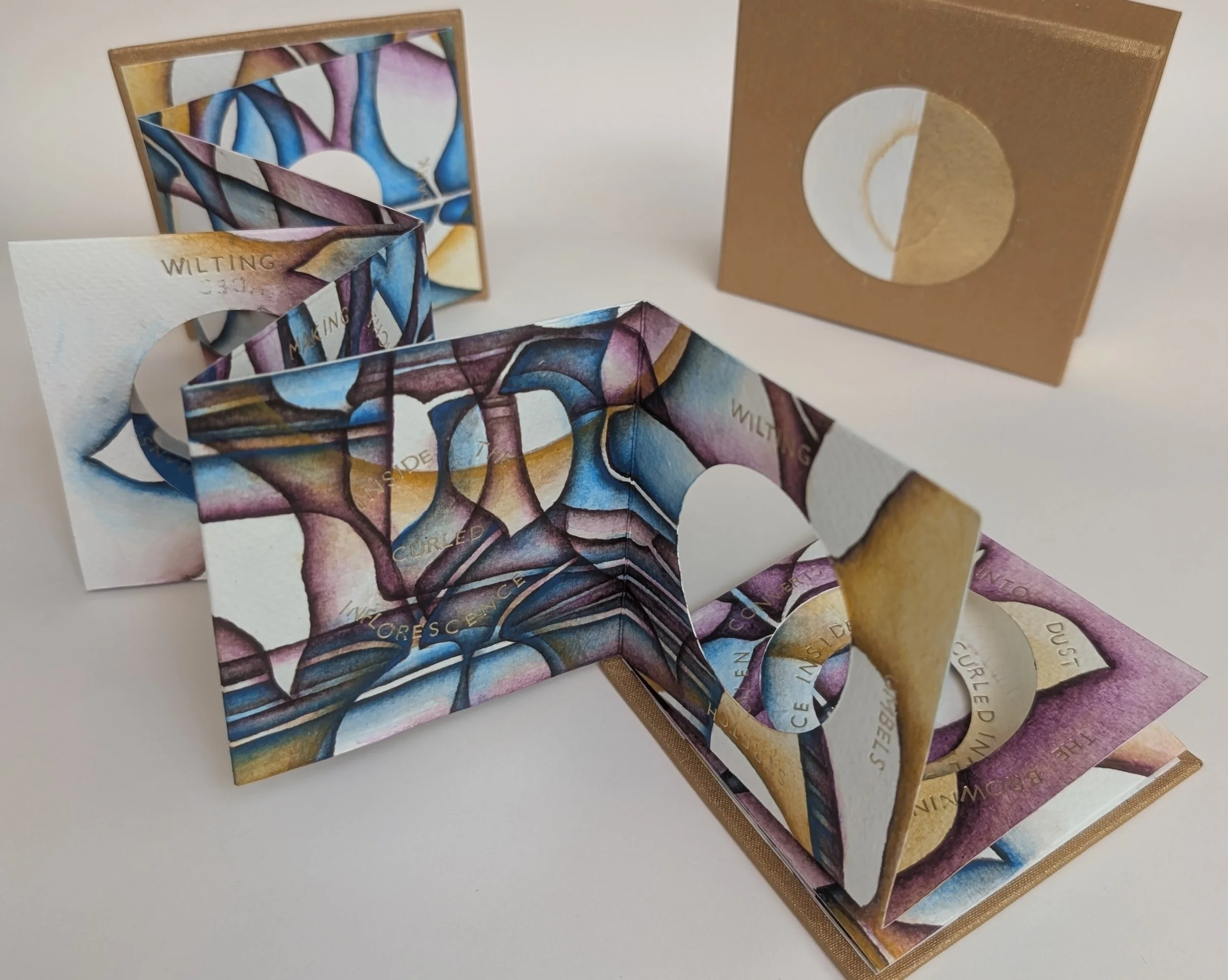
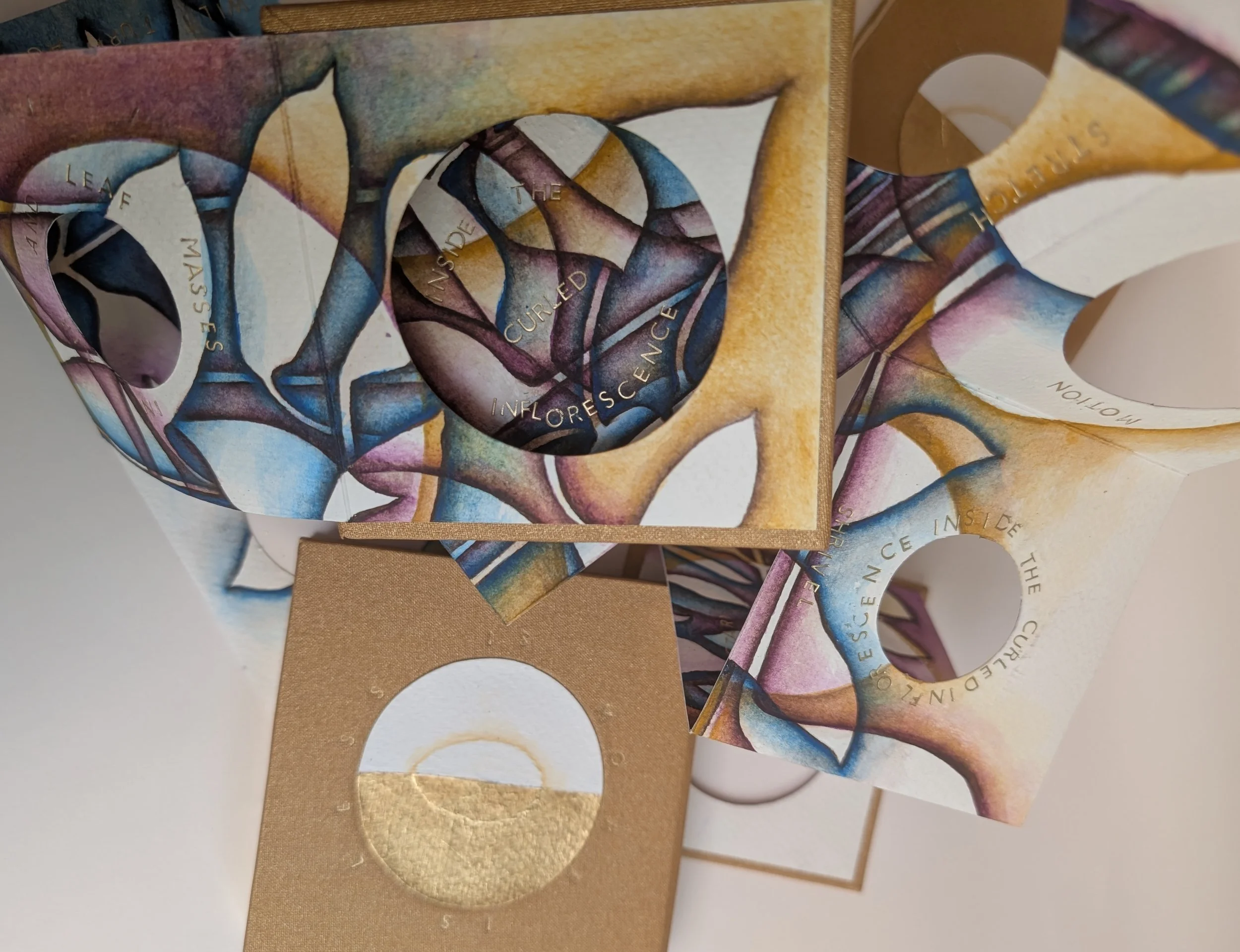
More Is Less depicts these effects of anthropogenic climate change on vegetation in the form of a pantoum. The hand-tooled gold lettering that spirals across the pages of this book combines words associated with plant growth, mechanical systems, and weather into a repetitious poetic form that conveys a sense of growth, turning, transformation, struggle to adapt, and pressure mounting.
This is reinforced by the concertina form of More Is Less, and the circular cut-outs that interrupt its hand-painted pages, leading the reader on meandering paths through the book, in which they repeatedly encounter familiar elements shifting and echoing. The book pages and outer solander box also include dried leaf specimens which have been gilded, in a gesture towards the botanical habit of preserving remnants of extinct plants, as collage elements that supplement the overall portrait of environmental degradation due to greening, a colour which is absent from the book.
In these ways, More Is Less enacts a cyclical portrayal of the cumulative processes of vegetal and environmental degradation that have been caused by the intrusion of human methods of growth and organisation into natural processes. At a time when global commitment to climate action hangs in the balance, this portrait of global vegetal and botanical emergency highlights the importance of all efforts to support vegetation resilience, and to conserve, restore, and protect the world’s plant community.


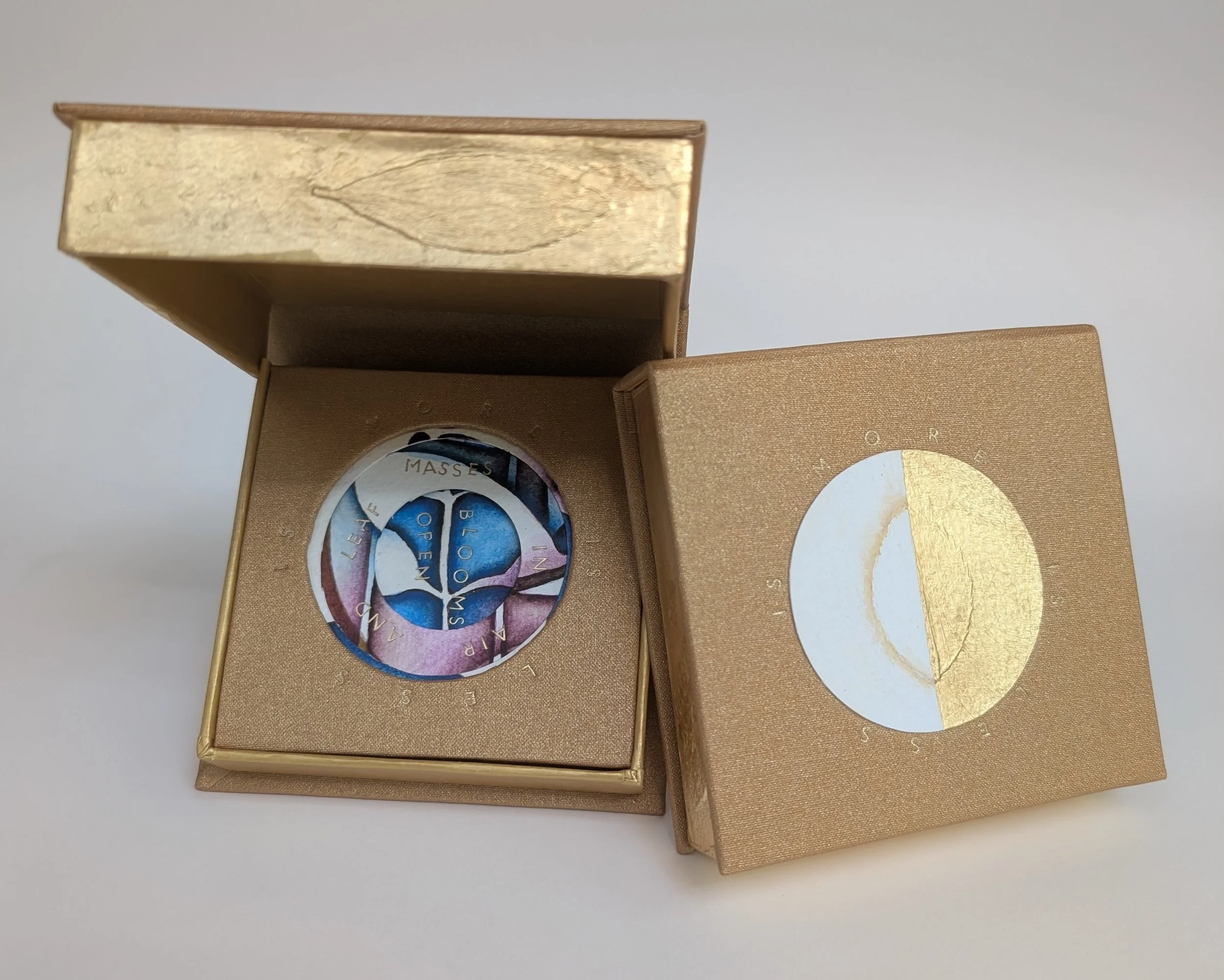
Jennie Cole, More Is Less (2026)
Details:
Book measures approximately 11.3 x 11.9 x 3 cm (in box). As each book is handmade, dimensions may vary slightly.
Outer solander box contains a pamphlet-stitched booklet digitally printed on gold paper with a short essay about the book and its context.
Outer box encloses hand-painted concertina book with circular cut-outs and hand-tooled lettering. This concertina book is a poem of text and image in the form of a pantoum that depicts ideas and processes of vegetation degradation in this era of climate crisis.
Hand painting in acrylic paint, hand tooling in gold foil, gold leaf on dried leaf collage, and digital printing.
Edition of 9.
An artist’s book by Jennie Cole. Made in London, 2026.
Construction:
Inner concertina and solander box covers of Inspirations Metallic Cloth in Gold, hand-tooled with gold foil lettering.
Outer box also features hand-painted paper disc of leaf collage, gold leaf, and acrylic paint, pasted onto book board.
Solander box lined and edged with 150 gsm Daler-Rowney Canford Paper in Frosted Gold, with detail areas of gold leaf on dried leaf collage.
Inner booklet pages digitally printed on 150 gsm Daler-Rowney Canford Paper in Frosted Gold.
Inner concertina of 300 gsm Stonehenge Aqua Not (cold press) paper, hand-painted in acrylic paint, with hand-tooled gold foil lettering.